
What a Micromanager Really Is
Why Young Leaders Need to Recognize it Early
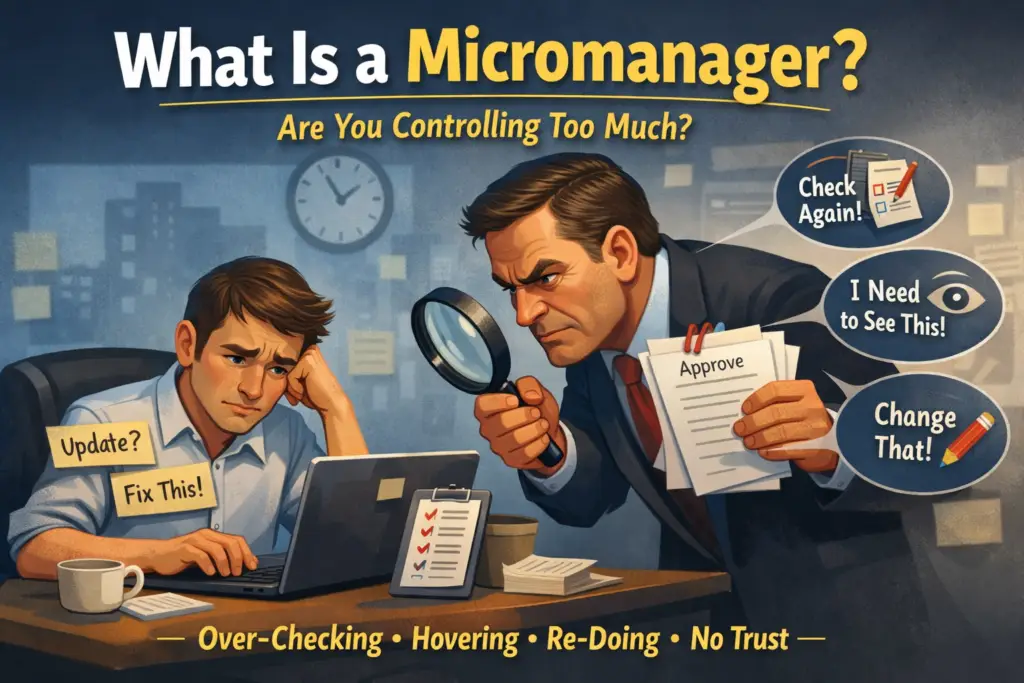
Micromanagement often looks like constant checking, overcontrol, and a lack of trust that leaves employees feeling pressure instead of ownership.
Story: When “Being Involved” Becomes Controlling
After posting my last article about micromanagers who do not recognize their own behavior, I realized many young leaders may not even know how to identify micromanagement. So I want to take a step back and explain what a micromanager is.
That matters because micromanagement rarely begins with bad intentions. In many cases, it begins with a leader who cares deeply, wants things done well, and feels responsible for the outcome. What starts as involvement slowly becomes overcontrol. What feels like helping begins to feel suffocating to the team.
A young leader may think:
“I’m just making sure it gets done right.”
“I’m only checking in because I care.”
“I’m trying to protect the team from mistakes.”
“I can do this faster myself.”
At first, those thoughts may sound responsible. But over time, that mindset can create a culture where people stop thinking for themselves, stop taking initiative, and wait to be told what to do next.
That is where micromanagement begins to do real damage.
A micromanager is not simply a leader who is detailed, organized, or highly accountable. Strong leaders can be all of those things. A micromanager is a leader who controls work with excessive attention to minor details, inserts themselves too often into tasks that should belong to others, and struggles to trust people with ownership. Maxwell Leadership defines micromanagement as controlling with excessive attention to minor details, and John Maxwell’s team ties the issue directly to trust and autonomy in leadership.
The difference is not whether a leader cares. The difference is whether that care leads to clarity and coaching, or to control and constant interference.
What a Micromanager Looks Like
Micromanagement often shows up in simple, everyday behavior:
A leader asks for updates too often, even when nothing has changed.
They redo tasks instead of coaching the employee who completed them.
They want to approve every decision, even minor ones.
They give responsibility, but not real authority.
They say they trust their people, but rarely let them work without interruption.
They become anxious when they are not copied on everything.
In other words, the team is never fully free to own the work.
Ken Blanchard’s leadership team describes micromanagement as “over-supervising,” noting that it can lead to duplication of work, frustration, poor morale, and loss of trust. That is one reason micromanagement is more than an annoying management habit. It changes the culture of a team. For more on this, visit Four Reasons Why Flexing Your Leadership Style Builds Trust.
Why Micromanagement Is So Harmful
Micromanagement may improve control in the short term, but it usually weakens leadership in the long term.
When leaders hover over every task, employees learn a dangerous lesson: “You are responsible, but you are not trusted.” That message quietly affects motivation, confidence, creativity, and ownership.
Instead of developing people, micromanagement trains dependence.
Instead of producing initiative, it produces hesitation.
Instead of building a healthy team, it builds a bottleneck around one leader.
Harvard Business Review highlighted research showing that helpful managers are not the ones who constantly step in, but the ones who communicate their intentions clearly, time their involvement well, and find the right rhythm of support. That distinction matters. Leadership is not about disappearing. It is about being involved in a way that actually strengthens people rather than shrinking them.
Why Young Leaders Often Fall Into It
Many young leaders do not become micromanagers because they are arrogant. They become micromanagers because they are insecure, untrained, or afraid of failure.
Sometimes they were promoted because they performed well individually, and now they struggle to stop doing and start leading.
Sometimes they think good leadership means always having the answer.
Sometimes they believe mistakes reflect directly on them, so they tighten their grip on everything.
Sometimes they inherited a broken culture and feel pressure to prove themselves immediately.
Micromanagement often grows where trust is weak and pressure is high. Leadership Freak warns that distrust breeds micromanagement, second-guessing, rules, sign-offs, and bureaucracy. That makes micromanagement as much a trust issue as a management issue.
“Do you micromanage? Think about it: why would that be motivational? People need to control their work day. It comes down to trust.” — John Maxwell Leadership Podcast, summarized on Maxwell Leadership
“Over-reliance on a single leadership style means many leaders end up over-supervising (a.k.a. micromanaging)… Perhaps the greatest casualty… is the trust they lose with team members.” — Blanchard LeaderChat
These quotes make the central issue clear: micromanagement is not just about control. It is about trust, motivation, and the kind of environment a leader creates.
The Leadership Tension: Oversight vs. Ownership
Of course, leadership does require oversight.
A leader should set standards.
A leader should clarify expectations.
A leader should monitor progress.
A leader should correct problems when needed.
But there is a difference between managing performance and controlling every movement.
Healthy oversight says:
“Here is the goal.”
“Here is the standard.”
“Here is when we will check in.”
“Let me know where you get stuck.”
Micromanagement says:
“Let me see every draft.”
“Do it this exact way.”
“Check with me before every step.”
“I know I assigned it to you, but I still need to control it.”
One builds leaders. The other builds dependency.
What Healthy Leadership Looks Like Instead
The answer to micromanagement is not negligence. It is not stepping back so far that people feel abandoned. Blanchard notes that over-supervising and under-supervising are both harmful. Good leadership finds the right level of guidance for the person, the task, and the moment.
Healthy leaders do a few things well:
They define the outcome clearly.
They explain what success looks like.
They give the person room to think.
They establish check-in points instead of constant interruption.
They coach after mistakes instead of panicking during the process.
They remember that developing people matters just as much as finishing the task.
That is what young leaders need to learn early: leadership is not proving that you can do everything better than everyone else. Leadership is helping others grow strong enough to do meaningful work without needing you at every moment.
Application: Questions Every Leader Should Ask
If this article hits close to home, here are a few honest questions worth asking:
Do I delegate tasks, but still control how every detail gets done?
Do I interrupt people because I am helping, or because I am uncomfortable letting go?
Do my employees need my approval for things they should already own?
Am I developing decision-makers, or am I creating dependency?
When something goes wrong, do I coach, or do I take everything back?
Self-awareness matters here. A leader can care deeply and still become controlling. A leader can have high standards and still unintentionally drain confidence from the team.
The goal is not guilt. The goal is recognition.
Because once a leader recognizes micromanagement, they can begin replacing it with clarity, trust, accountability, and better coaching.
Takeaway
Micromanagement is not strong leadership. It is usually fear dressed up as involvement.
A micromanager is a leader who cannot stop controlling what should be entrusted to others. They stay too involved in the details, struggle to release ownership, and unintentionally communicate distrust.
Young leaders need to recognize this early because the habits they form now will shape the culture they build later.
The best leaders do not measure their value by how involved they are in every detail. They measure it by how well they equip others to think, act, and grow. Micromanagement may create short-term control, but trust-based leadership creates long-term strength. If you want to lead well, do not ask whether your team needs you in every moment. Ask whether your leadership is helping them become more capable, more confident, and more prepared to lead themselves.
References
Blanchard. “Four Reasons Why Flexing Your Leadership Style Builds Trust.” June 29, 2023.
Fisher, Colin M., Teresa M. Amabile, and Julianna Pillemer. “How to Help Without Micromanaging.” Harvard Business Review, January–February 2021.
Harvard Business Review. “Stop Micromanaging and Give People the Help They Really Need.” December 29, 2020.
Rockwell, Dan. “Trust Is Given Not Earned.” Leadership Freak, October 25, 2015.
Maxwell Leadership. “Improving Your Micromanagement.” June 19, 2025.
Recommended Reading
Turn the Ship Around! by L. David Marquet
This is a strong recommendation for an article on micromanagement because it centers on moving away from a controlling, leader-dependent model and toward a culture of ownership, trust, and initiative. The publisher describes Marquet’s approach as a shift from the traditional “leader-follower” structure to one that develops leaders at every level.
Empowerment Takes More Than a Minute by Ken Blanchard, John P. Carlos, and Alan Randolph
This book fits well because it directly addresses the need to move beyond command-and-control leadership and build an empowered, employee-driven environment. The publisher describes it as a guide to recognizing and unlocking the skills, experience, and knowledge already present in an organization.