
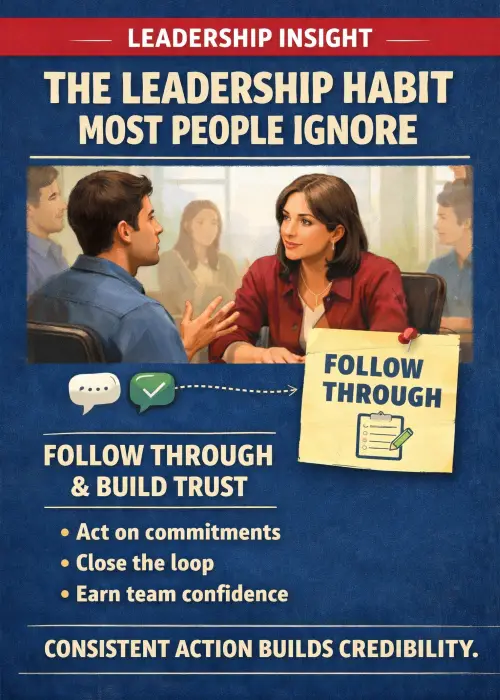
Story: The Quiet Discipline Behind Strong Leadership
When people think about leadership habits, they usually picture visible things.
They think about confidence in meetings, strong decision-making, clear communication, strategic thinking, or the ability to motivate a team during a difficult season. Those things matter. They are part of leadership. But one of the most important leadership habits is often overlooked because it does not look impressive from the outside.
It is the habit of follow-through.
Not flashy follow-through. Not dramatic promises. Just steady, consistent, dependable follow-through.
It shows up when a leader says, “I’ll look into that,” and actually does.
It shows up when a leader notices a concern, addresses it, and circles back.
It shows up when a leader commits to making an improvement and stays with it long after the initial conversation is over.
Most people underestimate how much trust is built or broken in those ordinary moments.
Imagine an employee brings a problem to a manager. The manager listens, nods, and responds kindly. In the moment, the employee feels heard. But days pass. Then weeks. Nothing changes. No update is given. No action is taken. Eventually the employee learns something important: the conversation sounded supportive, but it did not lead anywhere.
Now imagine a different leader in the same situation. This leader may not have the perfect answer immediately. They may even admit they need time to think, gather facts, or speak with others first. But then they return with an update. They explain what they found. They clarify what can and cannot be done. They take one next step and communicate it clearly.
That second leader may not appear more charismatic. They may not be the loudest voice in the room. But over time, they become the person people trust.
Why?
Because employees learn that when this leader says something, it means something.
That habit matters more than many leaders realize.
Teams do not only evaluate leaders based on major speeches, big decisions, or annual goals. They evaluate them in small, repeated moments. Did the leader do what they said they would do? Did they return the call? Did they address the issue? Did they provide the support they promised? Did they remember what mattered to the team?
Leadership is not only built on vision. It is built on credibility. And credibility is built through follow-through.
That is one reason this habit is so often ignored. It feels too basic to be called leadership. Yet in many workplaces, the gap between what is said and what is done is one of the biggest causes of frustration, disengagement, and mistrust.
People can handle hard news.
People can handle limits.
People can even handle “no” better than many leaders think.
What wears teams down is uncertainty, inconsistency, and silence.
When leaders fail to follow through, they unintentionally teach people not to take them seriously. Eventually employees stop raising concerns, stop offering ideas, and stop believing change is possible. Not because they do not care, but because experience has taught them that speaking up leads nowhere.
On the other hand, a leader who follows through creates a very different environment. People speak more openly. They ask better questions. Problems surface sooner. Accountability becomes more natural because the leader models it first.
That is the leadership habit most people ignore.
Not because it is unimportant.
Because it is so ordinary that many fail to recognize how powerful it really is.
Lesson: Leadership Is Proven in the Space Between Words and Action
A leader’s intentions matter, but intentions alone do not create confidence.
What creates confidence is the repeated connection between words and action.
This is where many leaders struggle. They are sincere. They care. They mean well. But leadership is demanding, calendars are crowded, and new priorities constantly appear. It becomes easy to move from one issue to the next without closing the loop on the last one.
That may seem small to the leader. To the team, it rarely feels small.
When follow-through is missing, employees often interpret it in one of three ways:
First, they assume the issue was not actually important.
Even if a leader sounded concerned, inaction sends a louder message.
Second, they assume the leader is disorganized or unreliable.
That weakens confidence, especially during stressful or uncertain seasons.
Third, they assume communication is mostly performative.
In other words, the leader says the right things but does not truly lead change.
That is why follow-through is not just an operational habit. It is a character habit. It reveals seriousness, discipline, ownership, and respect.
A leader who follows through communicates:
“I heard you.”
“I meant what I said.”
“You can count on me.”
“What happens next matters.”
This does not mean leaders must solve every problem immediately. It does not mean they always have to say yes. It does not mean they must personally handle everything.
It means they must be dependable.
Dependable leaders reduce confusion.
Dependable leaders increase trust.
Dependable leaders make accountability feel fair rather than forced.
In many ways, follow-through is what turns leadership from a concept into a reality.
Anyone can make promises in a meeting.
Anyone can sound thoughtful in the moment.
Anyone can talk about culture, standards, and support.
But leadership becomes real when action consistently backs it up.
As Peter Drucker famously noted, “Plans are only good intentions unless they immediately degenerate into hard work.” That principle applies directly to leadership. Good intentions are not enough. Teams are strengthened by what leaders repeatedly do, not merely by what they intend.
John Maxwell also wrote, “People buy into the leader before they buy into the vision.” That buy-in does not usually come from polished language alone. It comes from lived evidence that the leader is trustworthy, disciplined, and consistent.
In everyday leadership, that evidence is often found in follow-through.
Application: How to Build the Habit of Follow-Through
The good news is this habit is not complicated. It is simple. But it does require discipline.
Here are a few practical ways leaders can strengthen it.
1. Stop promising more than you can deliver
Many leaders damage credibility by speaking too quickly. In the moment, they want to sound helpful, supportive, or responsive. So they make commitments before thinking through capacity, authority, or timing.
A better approach is to slow down.
Instead of saying, “I’ll take care of it,” say, “Let me review this and get back to you by Thursday.”
That is not weaker leadership. That is more credible leadership.
2. Write it down
If a concern, request, or commitment matters enough to discuss, it matters enough to track.
Leaders who rely only on memory will eventually disappoint people. A simple notebook, task list, or follow-up system can make a major difference. The goal is not complexity. The goal is consistency.
3. Close the loop, even when the answer is no
One of the most overlooked forms of follow-through is communication.
Sometimes leaders cannot approve the request. Sometimes a process cannot be changed. Sometimes the answer is delayed. That is still a moment for leadership.
Closing the loop says, “I did not forget. Here is where things stand.”
People respect clarity more than silence.
4. Treat small commitments seriously
If leaders only follow through on major initiatives but ignore smaller commitments, trust still erodes.
The “small” things often matter most because they happen most often. A missed callback, forgotten update, or unresolved question may seem minor in isolation. Repeated over time, those moments define credibility.
5. Model the accountability you expect
Leaders often ask teams to be accountable, but teams notice whether the leader lives by the same standard.
When leaders own delays, admit misses, and correct them, they create a culture where accountability feels normal rather than threatening.
6. Make follow-through part of your leadership identity
Do not treat it like an administrative skill. Treat it like one of your leadership standards.
Great leaders are often remembered less for dramatic moments and more for steady reliability. People remember who could be counted on.
Takeaway
One of the most powerful leadership habits is also one of the least celebrated: follow-through.
It does not draw much attention. It rarely gets praised in dramatic ways. But it quietly shapes trust, accountability, morale, and culture.
Leadership is not only about what you say in the moment.
It is about what your team learns they can expect from you over time.
When your words consistently lead to action, people trust you.
When people trust you, they listen differently.
When they listen differently, leadership becomes stronger.
The habit most people ignore may be the one that matters most.
Leadership Habit to Practice This Week:
Choose one commitment you have already made to your team and intentionally close the loop on it.
Ask Yourself:
- Have I been clear about what I will do?
- Have I followed through on recent commitments?
- Where might silence be weakening trust?
- What small action can I complete this week to strengthen credibility?
Remember:
Trust is often built in the ordinary moments when leaders do what they said they would do.
Recommended Books for Further Reading
1. The 21 Irrefutable Laws of Leadership by John C. Maxwell
A strong resource for understanding how trust, influence, and consistency shape leadership effectiveness.
2. The Effective Executive by Peter F. Drucker
Excellent for leaders who want to strengthen execution, discipline, and responsibility.
3. Leaders Eat Last by Simon Sinek
Helpful for understanding how trust and leader behavior affect team culture and commitment.
4. The Speed of Trust by Stephen M. R. Covey
A practical book that connects trust directly to leadership performance and organizational health.
Quotes and References
“Plans are only good intentions unless they immediately degenerate into hard work.” — Peter F. Drucker, Management: Tasks, Responsibilities, Practices
“People buy into the leader before they buy into the vision.” — John C. Maxwell, The 21 Irrefutable Laws of Leadership